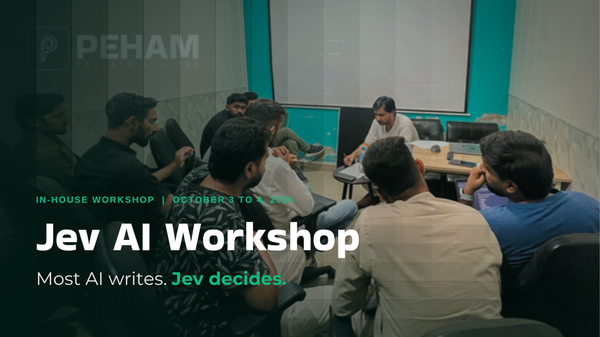
On October 3 and 4, our development team spent two days at Peham HQ working through one question: does every AI task in our software need a large language model?
For a lot of the work, the answer is no. The workshop centered on Jev, a decision model from TypeSafe AI. Most AI models write. Jev decides. It takes an input and a set of defined questions, then returns structured answers with probabilities and a confidence score instead of paragraphs of text.
What Jev is
TypeSafe AI released Jev in early access on September 15, 2026 and calls it a System One model: a model built for fast decisions inside software, not for conversation. You can read the details in TypeSafe's launch announcement.
That makes it a fit for the small judgement calls that run through most business software:
- Sorting a customer inquiry into the right category
- Sending a request to the right team
- Picking the next step in an automated workflow
- Checking information against set criteria
- Scoring a lead or a task
None of these needs a model that can write an essay. They need a quick answer the software can act on, and a way to tell how sure that answer is.
How the workshop ran
We kept it hands-on rather than running it as a lecture.
- Icebreaker. We opened with a short icebreaker so everyone was comfortable speaking up from the start.
- Cross-questioning. Throughout the sessions, participants answered questions and challenged each other on what Jev can and cannot do, and why a decision model behaves differently from a generative one.
- Team task. We closed with a group exercise where teams applied the ideas to a practical development problem.
Three things we took away
1. Not every task needs a large language model
Classification, routing and choosing between fixed options don't use what makes an LLM expensive. A decision model can return the answer faster and at a lower cost. The first question for any AI feature is what the task actually is. The model choice follows from that.
2. Decision models and LLMs work best together
The two don't compete. A decision model can work out what kind of message a customer sent, then pass it to a language model to write the reply. Each does the part it was built for, which keeps the workflow faster and cheaper to run.
3. Know where a tool stops
Jev does not write text or hold a conversation, and it isn't meant to. Knowing that boundary is what stops a team from forcing a tool into the wrong job. We now weigh what an AI tool can't do as carefully as what it can.
Where this fits in our products
We build vertical SaaS products, so the discussion quickly turned to our own work. Two products came up most.
Tejarify, our sales and inventory platform for retailers and wholesalers, handles a steady flow of orders, stock movements and requests that need sorting and routing.
DealDesk, our CRM for real estate professionals, tracks leads, follow-ups and sales activity. Deciding which lead needs attention next is a constant job there.
For both, we agreed on the same rule: add AI where it makes a measurable difference, not because it is popular.
From the team
"The Jev AI workshop was an insightful and valuable learning experience. It strengthened my understanding of how decision-focused AI models can improve efficiency and optimize workflows. The interactive discussions and collaborative activities made the session both engaging and practical."
Hammad Zahoor, Fullstack Engineer
"The Jev AI workshop was a valuable learning experience that highlighted how AI can improve productivity, automate workflows, and address real-world development challenges. I gained practical insights into how we can integrate AI into our projects to improve development efficiency, reduce repetitive tasks, and build smarter solutions."
Muhammad Umair Arshad, Full Stack Developer
"The most valuable thing I learned at the Jev AI Workshop was how to use AI tools practically in everyday development work. The workshop was well organized, and the team activities made it fun and easy to learn. I think this will help us save time on repetitive tasks and build smarter features in our future projects."
Syed Murtjiz, Frontend Developer
Highlights on Instagram
View this post on Instagram
View this post on Instagram
View this post on Instagram
What's next
Workshops like this are how we keep the team current on tools that are still new. The aim isn't to adopt everything that ships. It's to understand each tool well enough to use it in the right place.
If you're working out where AI belongs in your own product, talk to our team. Follow @pehamltd on Instagram for our next workshop.